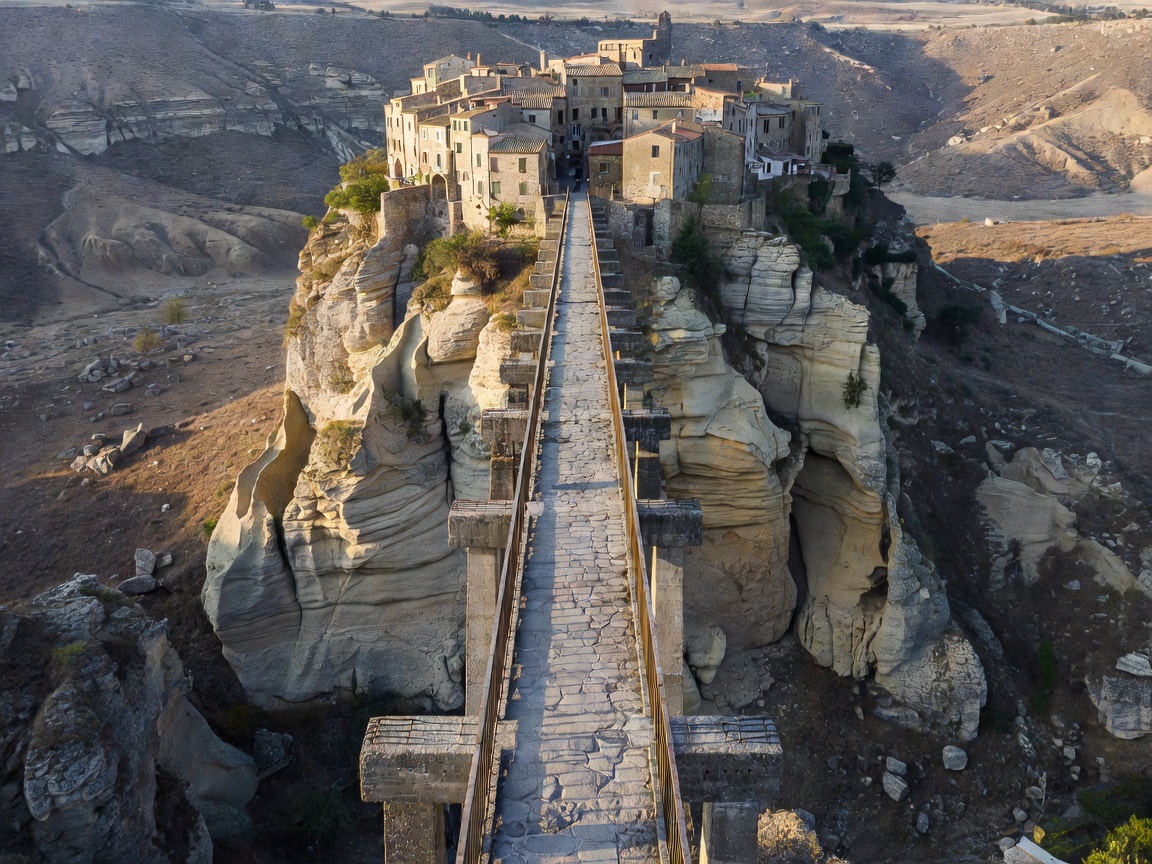
Origins, Geology and Vulnerability
Founded by Etruscans more than 2,500 years ago, Civita di Bagnoregio sits atop a plateau composed of volcanic tuff overlying softer sedimentary clay. The underlying clay layers are continually worn away by rainfall, underground aquifers, and the erosion of the Rio Chiaro and Rio Torbido ravines. This phenomenon earned the settlement its poignant historical moniker: la città che muore (the dying town).
Rather than surrendering to dissolution, the community developed ingenious civil-engineering interventions. In recent decades, geologists have installed structural anchoring bolts and subsurface drainage wells to stabilize the cliff perimeters, demonstrating how community stewardship can counteract continuous tectonic fragility.
Navigating the Medieval Fabric
The entrance to the village is marked by the 12th-century Romanesque arch of Porta Santa Maria, carved directly out of the stone face. Bas-relief sculptures of lions gripping human heads flank the entrance—a reminder of the medieval townsfolk who successfully expelled the Monaldeschi tyrants of nearby Orvieto.
Once inside, motor vehicles are physically impossible. Narrow alleys open up into Piazza San Donato, a compact central square unpaved in traditional dirt and terracotta pavers, framed by the Romanesque Church of San Donato. The interior houses a revered 15th-century wooden crucifix attributed to the school of Donatello, venerated annually during Good Friday processions.
Culinary Profile & Regional Specialties
Because fertile soils surround the valley, the culinary profile of Bagnoregio draws deeply from northern Lazio and nearby Umbrian traditions:
- Picchiarilli pasta: Hand-rolled thick wheat dough strings dressed in rich porcini mushroom or wild boar ragù.
- Olio di Canino: Extra virgin olive oil pressed from indigenous Caninese olives, notable for high polyphenol concentrations and grassy bitterness.
- Tuscia hazelnuts and honey: Used widely in traditional almond pastries and dry cookies paired with sweet local Est! Est!! Est!!! di Montefiascone wine.
Advantages for Travelers
- Entirely pedestrian environment devoid of automobile noise and pollution.
- Extraordinary 360-degree panoramic viewpoints over the Valle dei Calanchi.
- Significant photographic and geological educational value.
Practical Challenges
- Steep footbridge ascent requires reasonable physical mobility.
- Nominal entry conservation fee required at the bridge foot.
- Very limited overnight lodging options within the historic walls.
Logistical Considerations for Respectful Visits
To manage ecological impact, municipal authorities require visitors to purchase a pedestrian access ticket at the Bagnoregio side before crossing. Arrive early in the morning or remain toward late afternoon when day-trippers disperse, allowing you to observe the resident artisans and local cats taking reclaim of the limestone squares. Respect posted structural warning signs along cliff-edge alleyways, where unstable rock formations are continuously monitored by seismic instruments.